Power requirements: Waukesha-type Carlsen positive displacement pumps (W30 through W130) and Waukesha centrifugal pumps run on 220V single phase, 230V three phase or 480V three phase. The W220 and W320 are three phase only. No three phase at your winery? Ask us about affordable phase converters.
Type 1: Waukesha-Type Carlsen Positive Displacement Pumps
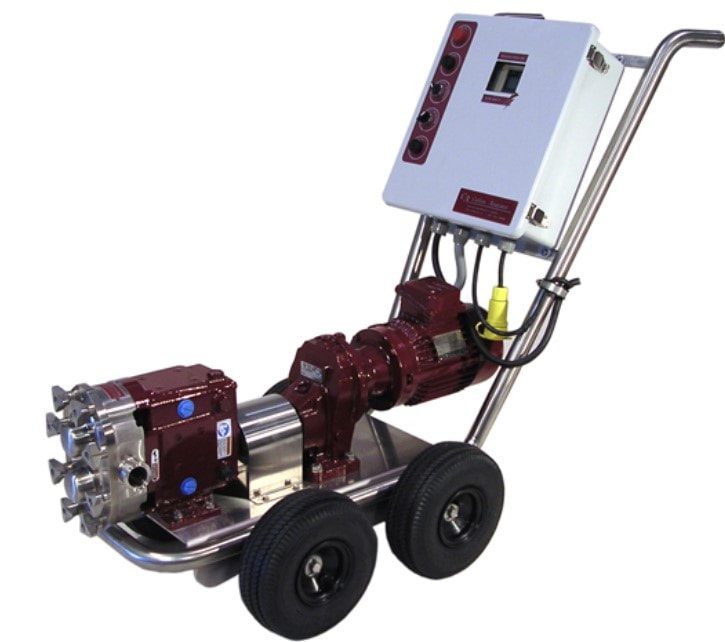
Used worldwide in wine, beer, dairy, cosmetics and pharmaceuticals, the Waukesha is a household name in our country. When you look at a Waukesha-type Carlsen pump, you're looking at that same robust design, made in the very plant where Waukesha pumps used to be made. It's the strongest and gentlest wine pump and must pump in our industry.
This self-priming pump will not increase solids or vegetal characteristics in wine during must pumping or pumpovers. Enjoy lower dissolved oxygen and more work done with less stress on the wine.
Carlsen's own Waukesha-type head and rotors, made in that same American plant, are added to an all-star list of Carlsen-specific parts in an unbeatable combination. From the pump head to the cart to the variable frequency drive, it's uniquely Carlsen. Others may offer a Waukesha-style head on a cart, but you won't find our warranty, support, service or knowledge elsewhere.
Waukesha-Type Carlsen Pump Sizes and Uses
Our Waukesha-type Carlsen pumps come in six sizes, sized in gallons per minute. The W30 through W130 run on 220V single phase, 208/230V three phase, or 480V three phase; the W220 and W320 are three phase only (208/230V or 480V). Specify at time of order.
| Pump | W301–30 GPM · 1½" T/C | W401–40 GPM · 2" T/C | W601–70 GPM · 2½" T/C | W1301–135 GPM · 3" T/C | W2201–220 GPM · 4" T/C | W3201–320 GPM · 6" Camlock |
|---|---|---|---|---|---|---|
| Bottling at scale | Yes | Yes | Yes | Yes | Yes | Yes |
| Filtration (not with D.E.) | Yes | Yes | Yes | Yes | Yes | Yes |
| Transfer | Yes | Yes | Yes | Yes | Yes | Yes |
| Pumpover | No | No | Yes | Yes | Yes | Yes |
| Pumping must | No | No | No | Yes | Yes | Yes |
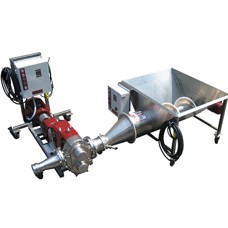
Turn a W130, W220 or W320 into a must pump with the Carlsen must sump. About the must pumping system. Keeping yours running? See care and feeding of Waukesha-type pumps.
Waukesha-Type Carlsen Pump Specifications
| Pump | W30 | W40 | W60 | W130 | W220 | W320 |
|---|---|---|---|---|---|---|
| Maximum flow | 30 GPM | 40 GPM | 70 GPM | 135 GPM | 220 GPM | 320 GPM |
| Bottling speed | 150 BPM | 200 BPM | 300 BPM | – | – | – |
| Maximum pressure | 60 PSI | 60 PSI | 60 PSI | 80 PSI | 100 PSI | – |
| Ports | 1½" Tri-Clamp | 2" Tri-Clamp | 2½" Tri-Clamp | 3" Tri-Clamp | 4" Tri-Clamp | 6" Camlock (one male, one female supplied) |
| Must pumping | – | – | – | Up to 15 tons/hr | Up to 50 tons/hr, whole berries with juice | Up to 80 tons/hr, whole clusters |
| Seals | Single O-ring seals for easy replacement and cleaning | Mechanical seals | ||||
| Size (L × W × H) | 53" × 21" × 40¼" | 53½" × 21" × 40¼" | – | 54" × 21" × 40¼" | 68.7" × 24½" × 40⅝" | 72" × 38" × 49" |
| Port height (to center) | 12⅞" | 12⅞" | – | 15" | 18½" | 15" |
| Standard | Stainless steel pump head and rotors; stainless steel cart (casters or wheels); variable speed with a 50' speed control; reversible flow on the W220 and W320 | |||||
| Options | Float switch for press pans and pumpover sumps; pumpover timers; pressure transducer for barrel work; pressure switch for axial-feed press filling; remote start/stop with 50' cable | |||||
Pro Tip: Every Winery Needs Two Pumps. Picture harvest: your "Do-All" Waukesha-type Carlsen W130 is busy on must pumping duty while the press pan is filling up. A second pump with smaller throughput saves the day. It's also the right tool for topping barrels and feeding the filler at bottling. Not every pump needs to be capable of pumpovers and must pumping. If you have compressed air, a Yamada is a cost-effective second pump.
Type 2: Yamada Air Diaphragm Pumps
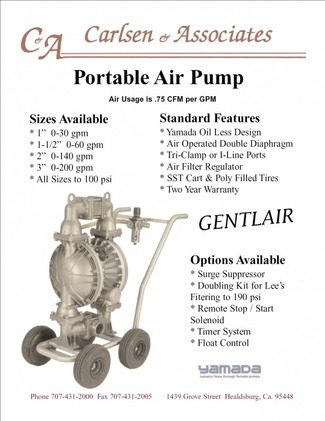
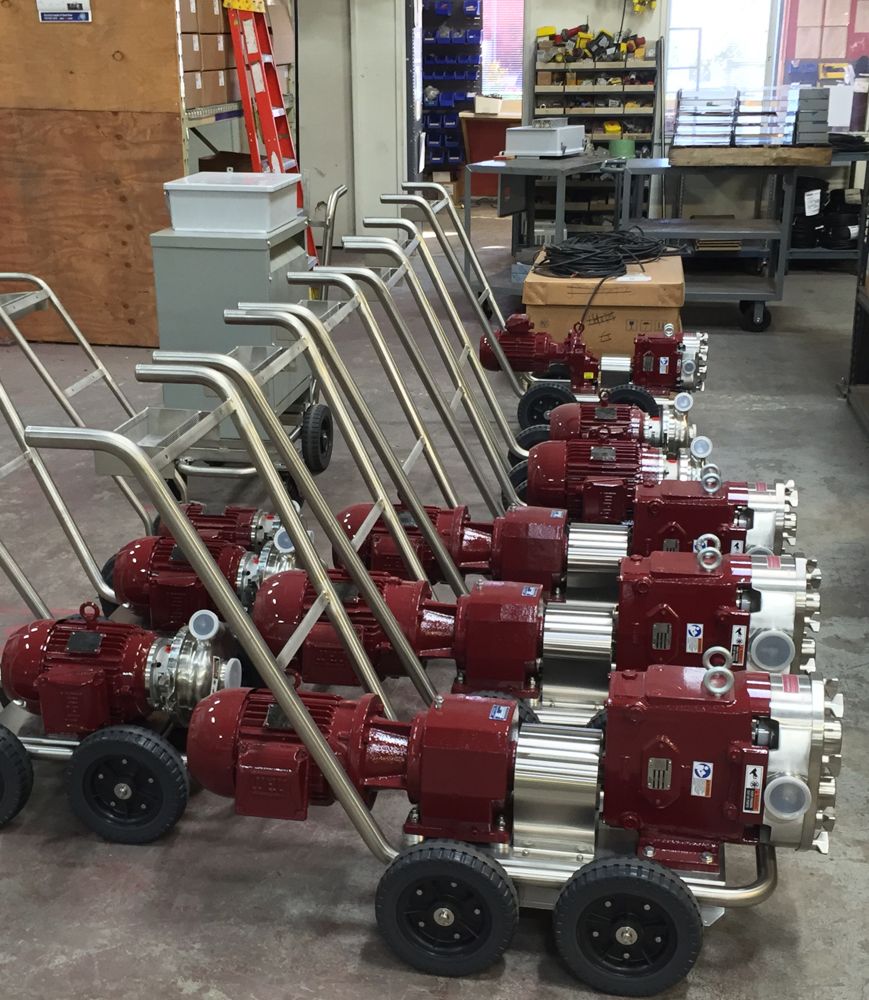
Yamada pumps are a cost-effective, food-grade, simple, easy-to-maintain pump that's great for barrel topping, transfers, some types of filtration, and pumping out a press pan. They run on compressed air, not electricity.
One neat feature: you can set the pressure output on the on-board regulator to a level that lets you close the downstream valve without yelling at someone to stop the pump 100 feet away.
The only possible downside is the need for compressed air. You probably need an air compressor anyway, so that's not the end of the world. Yamada owners enjoy the light weight, portability, functionality, and low risk of blowing up a hose.
Popular Yamada Sizes
| Model | Flow | Connection |
|---|---|---|
| Barrel topping system (Yamada G-15) | 0–15 GPM | Topping gun on 50' hose; Tri-Clamp or Camlock |
| NDP-25 | 30 GPM | 1½" T/C |
| NDP-40 | 60 GPM | 2" T/C |
| NDP-50 | 140 GPM | 2" T/C |
| NDP-80 | 200 GPM | 3" T/C |
Yamada Pump Specifications
| Model | Bore | Ports | Flow | Air required | Cart and pump body |
|---|---|---|---|---|---|
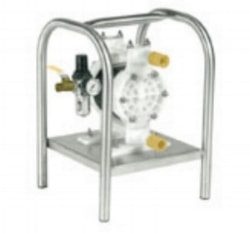
| NDP-15 | ½" | 1½" Tri-Clamp | 15 GPM | 10 CFM (3 HP compressor) | Hand-carry stainless cart, polypropylene pump |
| NDP-25 | 1" | 1½" Tri-Clamp | 30 GPM | 23 CFM (7.5 HP compressor) | Two-wheel cart, stainless steel pump |
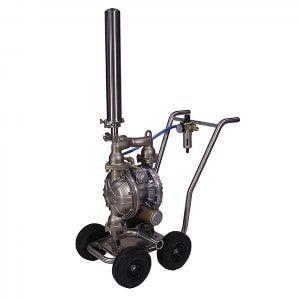
| NDP-40 | 1½" | 2" Tri-Clamp | 60 GPM | 45 CFM (15 HP compressor) | Four-wheel cart, stainless steel pump |
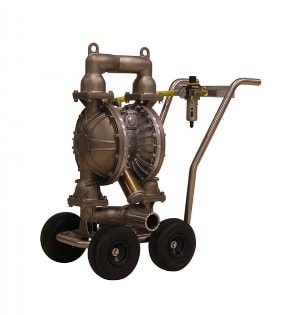
| NDP-50 | 2" | 2" Tri-Clamp | 140 GPM | 100 CFM (35 HP compressor) | Four-wheel cart, stainless steel pump |
| NDP-80 | 3" | 3" Tri-Clamp | 200 GPM | 150 CFM (50 HP compressor) | Four-wheel cart, stainless steel pump |
| Every pump | Cart, parts basket, air pressure regulator, air flow control valve and surge suppressor (except the NDP-15). Low shear, self priming, runs dry, can be dead-headed, no mechanical seals or motors, explosion proof when grounded. Optional flip cart for draining the NDP-40 and NDP-50. | ||||
| Barrel Topping System | Specification |
|---|---|
| Flow and pressure | 0 to 15 GPM, up to 100 PSI |
| Pump | Yamada G-15 air-operated double diaphragm, polypropylene body for light weight, Hytrel diaphragms |
| Air usage | 0.65 CFM per GPM; air filter regulator included |
| Included | Stainless portable frame; barrel dip tube with 10' of inlet hose; stainless steel topping gun with 50' hose; Tri-Clamp or Camlock connections |
| Options | Setup for two guns; wheeled cart |
Type 3: Waukesha 200 Series Centrifugal Pumps
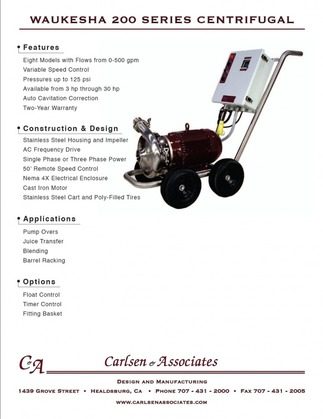
Centrifugal pumps are loved by brewers and winemakers alike. Our rugged centrifugals, with anti-cavitation technology, are genuine Waukesha, with the same great service and support as everything else from Carlsen. Popular with folks who love pumpovers and a lot of pump for the money, they can be a gravity-flow winery's go-to pump, or a great second pump. We offer them in several sizes, horsepower ratings and voltages.
See every model, flow and pressure: Waukesha centrifugal pumps, from the 2065/10 Washdown pump for tank cleaning to the 550 gpm 2105/25.
Centrifugal Pump Specifications
| Waukesha Centrifugals | Specification |
|---|---|
| Models | 2065HV/5, 2065/10 Washdown, 2085/10, 2085/15, 2105/20, 2105/25 (compare them) |
| Flow | 0 to 550 GPM across the line |
| Pressure | Up to 80+ PSI (2065/10 Washdown); 37 to 55+ PSI on the wine pumps |
| Motors | 5 HP through 25 HP, totally enclosed fan-cooled, cast iron housing |
| Construction | Stainless steel housing and impeller; stainless steel cart |
| Controls | Variable frequency drive; automatic cavitation correction built in |
| Uses | Pumpovers, juice transfers, blending, barrel racking, tank washing (2065-10) |
| Options | Float control; timer control; remote start/stop with 50' cable; automatic pumpover setups |
Winery Pump Questions
What pump does a winery need?
Two, sooner or later. A Waukesha-type Carlsen positive displacement pump is the workhorse: transfers, filtration, bottling, pumpovers and, from the W130 up, must. The second pump covers the jobs that pile up while the big one is busy at harvest, like the press pan, barrel topping and feeding the filler. If you have compressed air, a Yamada is the cost-effective second pump.
What size pump do I need?
Size it to the biggest job you'll ask of it. The W30 and W40 handle transfers, filtration and bottling. They differ in port size: the W30 has 1½" ports and the W40 has 2" ports. The W60 adds pumpovers. The W130 is our "Do-All": transfers, pumpovers and up to 15 tons an hour of must. The W220 and W320 are for bigger crush volumes. Tell us what you'll pump, how far and how high, and your power supply, and we'll size it with you.
Can I pump must with a wine pump?
With the right one. The W130, W220 and W320 pump must, and paired with the Carlsen must sump they move up to 15, 50 or 80 tons an hour. The winged rotors and tight clearances won't macerate grapes, so you get more whole berries, fewer broken seeds and less solids pickup. The W30, W40 and W60 are not must pumps. See the must pumping system.
Is a Carlsen pump a real Waukesha?
Our positive displacement pumps are Waukesha-type Carlsen pumps. The Waukesha-style winged rotor is what makes it a Waukesha-type pump, and Carlsen's head and rotors are made in the very plant where Waukesha pumps used to be made. The Carlsen parts list, cart, drive and assembly expertise since 1977 make it a Carlsen. Our centrifugal pumps are genuine Waukesha.
Are they self-priming? Can they run dry?
The Waukesha-type Carlsen pumps are self-priming and OK to run dry for short periods. Yamada air pumps are self-priming, run dry and can be dead-headed, which is why they make such a forgiving topping pump.
Do I need three-phase power?
Not for most of them. Every electric pump we sell is built for U.S. 60 Hz power. The W30 through W130 and the Waukesha centrifugals run on 220V single phase, 230V three phase or 480V three phase. The W220 and W320 are three phase only. Yamada pumps run on compressed air, not electricity. No three phase at your winery? Ask us about affordable phase converters.
Where do I get Waukesha pump parts and O-rings?
Through Joe or Nikki. The best way is to email us through the site with your pump model and what you need, and we'll get you the right O-rings, seals and parts. For the routine stuff, see care and feeding of Waukesha-type pumps and the service videos below.
How soon will my pump ship?
We usually ship pumps a few days after the deposit is received.
Why buy a winery pump from ENOTOOLS?
We're wine industry people, not salespeople. We'll size the pump to your cellar, and you get Carlsen-level service and warranty behind it, with Joe and Nikki a phone call away after it arrives.
Watch It Run
Pump care videos from Carlsen & Associates. Each opens on YouTube. More on our videos page.