
Your Destemmer May Be Better Than You Think
Before you spend money on a sorting system or a bigger destemmer, look at how you're feeding the one you have. A destemmer does its best work at a steady rate. Dump a bin straight in and it chokes, then runs empty, then chokes again. Feed it a metered flow of fruit and you can dial in its speed for cleaner separation, fewer stems in the must and more whole berries.
That's what a wine grape receiving hopper or incline conveyor is for: it turns half-ton bins into a constant, regulated feed for your destemmer, sorting table or press, at 1 to 25 tons per hour with the Carlsen 6' hopper.
Hopper or Belt? Or Both?
There are two ways to feed your crush pad a steady, gentle flow of fruit, and many wineries use both:
| 6' Horizontal Receiving Hopper | Incline Belt Conveyor | |
|---|---|---|
| Best for | Dumping half-ton bins on the fly | Fruit that's raked or dropped in, and changing the height of incoming fruit |
| Throughput | 1 to 25 tons per hour | 1 to 10 tons per hour |
| Fruit arrives in | Plastic, rotatable half-ton bins | Any bin you can tilt and rake from, including small lots |
| Crew | Two people: one on the forklift, one at the destemmer | Three: one on the forklift, one raking, one at the destemmer |
| How it moves fruit | Oversized, flight-edged, seamless auger | Variable-speed belt with cupped cleats that hold juice |
| Height | Discharge adjusts from 62¾" to 107¾" with a forklift | Screw jack raises or lowers the discharge |
| Use both | Receive with the hopper, then lift with the belt, for example from a sorting table or destemmer to the press or fermentor. | |
Which One Is Right for You?
- Choose the horizontal hopper if your fruit comes in plastic, rotatable half-ton bins and you want a two-person crush pad: dump the bin and go.
- Choose the incline belt if your fruit arrives in a mix of containers, if you want to pick out the occasional cluster you don't consider usable fruit, or if you need to lift fruit from a sorting table or destemmer up to a press or fermentor.
- Choose both if you want to receive fast and still move fruit up and over to the next step.
A word about cardboard bins: imported cardboard bins stapled to a wooden pallet can slide off the pallet and into the horizontal hopper in one piece. The only way to unload them properly is to put someone on a ladder to cut the side down and rake. If much of your fruit arrives that way, the incline belt is the better fit.
The Carlsen 6' Horizontal Receiving Hopper
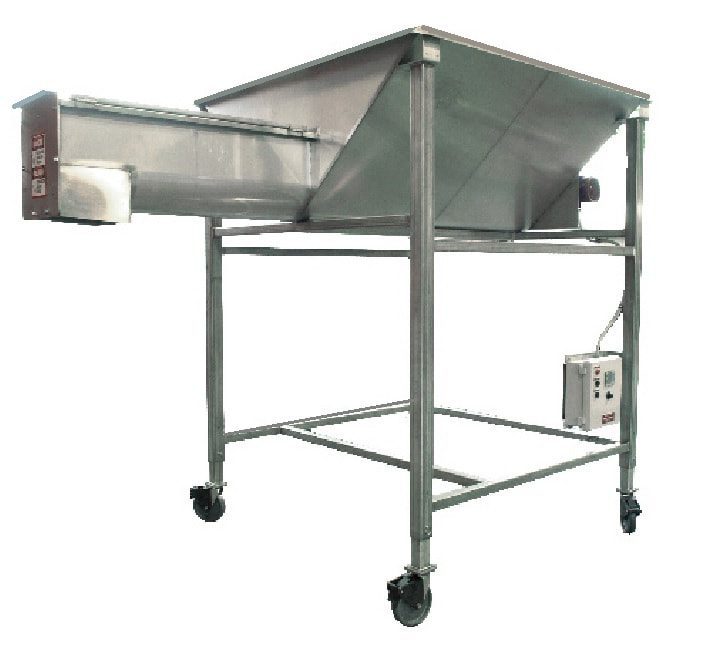
The most valuable piece of crush equipment on the planet.
How would you like to see 90% of the result of sorting simply by supplying your destemmer with a constant, regulated flow of grapes? Designed for dumping half-ton bins into on the fly, the Carlsen 6-foot horizontal receiving hopper is the key to the best results from your destemmer.
By supplying the destemmer with a specific flow rate of grapes, the operator can dial in the perfect speed at the destemmer. With hand-picked fruit, this can minimize the need for sorting. It saves labor and increases the quality of the destemmed fruit.
This Hopper Can Deliver
- Whole cluster fruit to the press
- Fermented red must to the press
- Fruit to the destemmer crusher
- Fruit to a sorting table
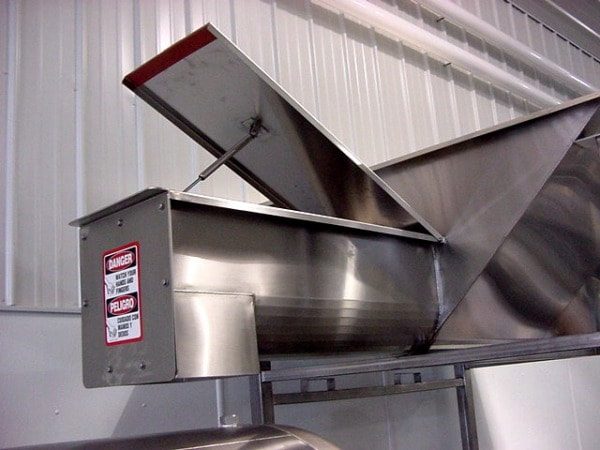
Height adjustments are made easily with the supplied forklift pockets, so the hopper works with your other crush equipment. Discharge height adjusts from 62¾ to 107¾ inches.
Not All Augers Are Created Equal
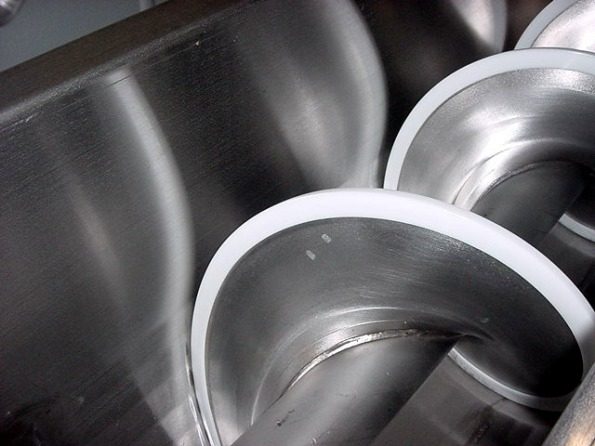
"Auger" is normally a violent, horrific word to use around grapes. This one isn't. It's a seamless, one-piece, continuously TIG-welded, oversized, polished screw with UHMW plastic flight edging and no end bearing. The shaft floats in the bottom of the trough and the flight edge becomes the bearing, so there's no bearing at the end for stems and skins to wrap around, and no pinch zone between the hopper floor and the screw. It seals so well against the bottom that you have to turn it on to get the rinse water to drain out after cleaning.
The result is negligible, if any, increase in solids. The bunches slide easily on the polished stainless interior, so the energy used to move the fruit isn't wasted. This design is gentler than hand-raking fruit out of a bin into the destemmer, and much more efficient, which saves labor. The grapes don't know they weren't dropped into the destemmer or press by hand.
6' Receiving Hopper Specifications
| 6' Receiving Hopper | Specification |
|---|---|
| Throughput | 1 to 25 tons per hour, depending on your forklift delivery |
| Hopper holds | ½ ton of hand-picked fruit or drained pomace |
| Hopper size | 72" × 72" at the top |
| Overall length | 133½" including the discharge |
| Discharge height | 62¾" to 107¾", adjustable in 5" steps |
| Rim (infeed) height | 116¾" to 139¾" |
| Auger | Replaceable, with UHMW flight edging and no end bearing; hinged top cover and removable front cover |
| Construction | All stainless steel; forklift pockets; made in the USA |
| Warranty | Two years |
| Drive | Variable speed control; single or three phase |
| Options | Remote start/stop with 50' cord; acrylic mirror on the mast to see into the hopper from the ground or forklift; magnet for machine-harvested fruit |
The Carlsen Incline Belt Conveyor
An alternative to the horizontal hopper, or a partner to it.
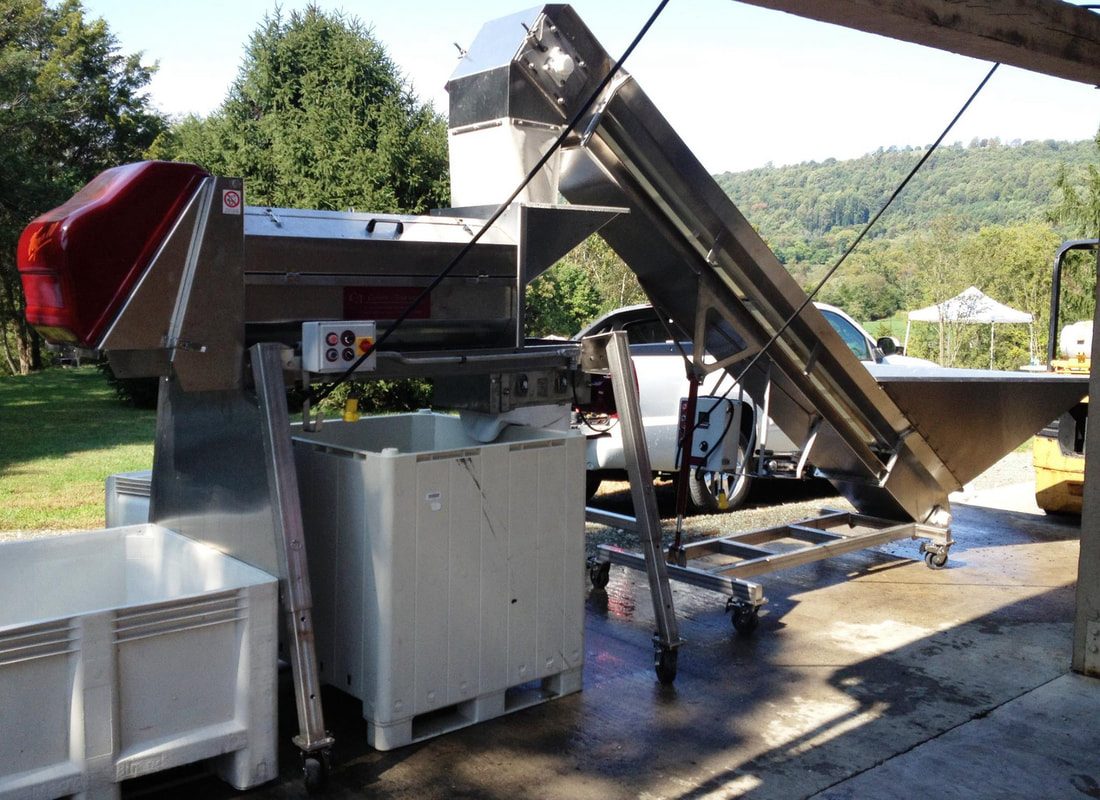
The last word in gentle mechanical movement of grapes. The American-made incline belt conveyor is variable speed with single- or three-phase power, which makes it very versatile anywhere you need to change the height of incoming fruit. A manual hydraulic ram raises or lowers the discharge height.
- Feed a destemmer or press
- Receive from a sorting table
- Receive from a destemmer
- Feed a fermentor
- Cupped belt cleats hold juice
- Metered, variable-speed feed
The best way to feed a destemmer with the incline: side-tilt a half-ton bin and take cleat-sized bites with a food-grade rake, matching the tempo of the fruit dropping onto the destemmer's infeed. The large hopper makes a nice target and keeps dropped fruit to a minimum.
This is not automated crush equipment or a labor-less system. There will be some care required to drop the correct amount of fruit into the intake.
Care: spray it out, cap the tank, fill it with sanitizer, and a sound wine will never show it touched the belt. Store it out of the sun, and take the tension off the belt at the end of harvest to make it last longer.
Incline Belt Conveyor Specifications
| Incline Belt Conveyor | Specification |
|---|---|
| Throughput | 1 to 10 tons per hour |
| Discharge height | 90" to 123", adjusted with a screw jack (optional drill adapter) |
| Standard hopper | About 30" × 38"; fits under a destemmer to load tanks or presses |
| Optional large hopper | About 64⅜" wide × 59" long |
| Motor | 2 HP with variable frequency drive; single or three phase |
| Belt | Food-grade nitrile belt with alligator lacing; curved cleats, 2" high, bonded on 12" centers; adjustable belt tension; belt scraper on the return side |
| Discharge | Food-grade flexible discharge chute |
| Construction | Stainless steel frame and body; open design for cleanup; cleanout port at the base; stainless steel casters with brakes |
Planning Your Crush Pad?
The receiving end sets the pace for everything after it. Tell us how your fruit arrives (bin type and tons per day), what you're feeding (destemmer, sorting table, press) and the power you have, and we'll help you choose and lay it out. See the Crushpad Package for a complete line, or get a price.